ACD Works Hard to Save Money for Local Taxpayers

 ACD collaborates with water management entities that share jurisdiction in Anoka County. There is a collection of watershed districts and watershed management organizations (WMOs) that cover all of Anoka County and fit together like puzzle pieces. 44% of ACD overlaps with well-staffed watershed districts and WMOs. The other 56% have no staff and rely solely on ACD to serve as their staff. The extreme efficiency that results from this partnership is remarkable.
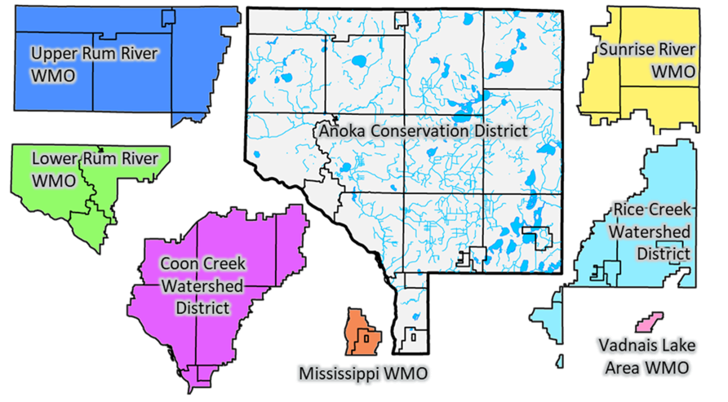
Photo: Anoka County is divided among 7 water management organizations, creating opportunities for strong partnerships. By combining efforts, local funding can be leveraged more effectively to maximize conservation outcomes and improve natural resources throughout the county.

 Wetland Regulation Specialist: Providing shared regulatory expertise reduces the need for independent hiring and consulting across approximately 10 local government units.

De Facto Technical Staff: ACD serves as the direct technical and operational staff for three watershed management organizations (Upper Rum, Lower Rum, and Sunrise River WMOs) covering approximately 60% of Anoka County.
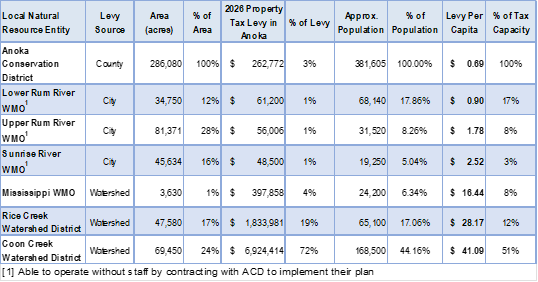
$ 1.52 Million in Local Taxpayer Savings: By consolidating administrative overhead and technical staff under ACD's lean framework, this shared-services model prevents these three WMOs from needing to hire independent administrators and project managers. Operating these regions independently would cost local taxpayers an estimated $1.95 million annually. By anchoring them to ACD, local taxpayers save a net $1,526,452 annually.

For more information contact Chris Lord, District Manager, at Chris.Lord.AnokaSWCD.org.

  8 Hits

2019 ACD Monitoring Season

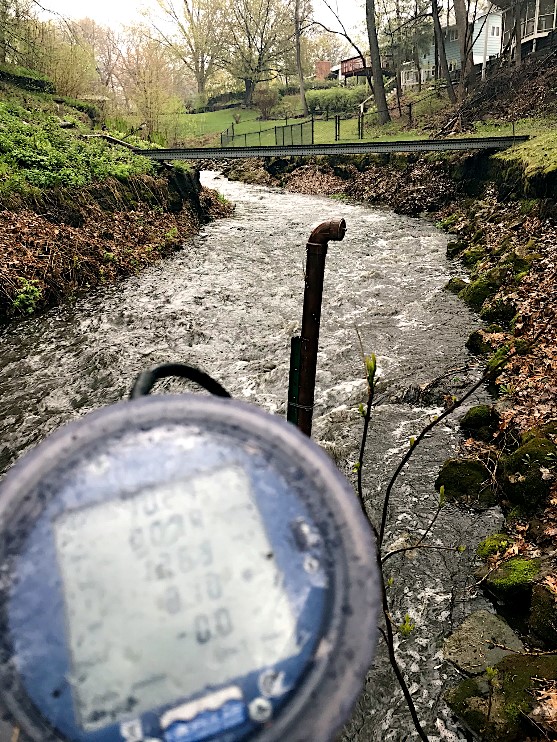
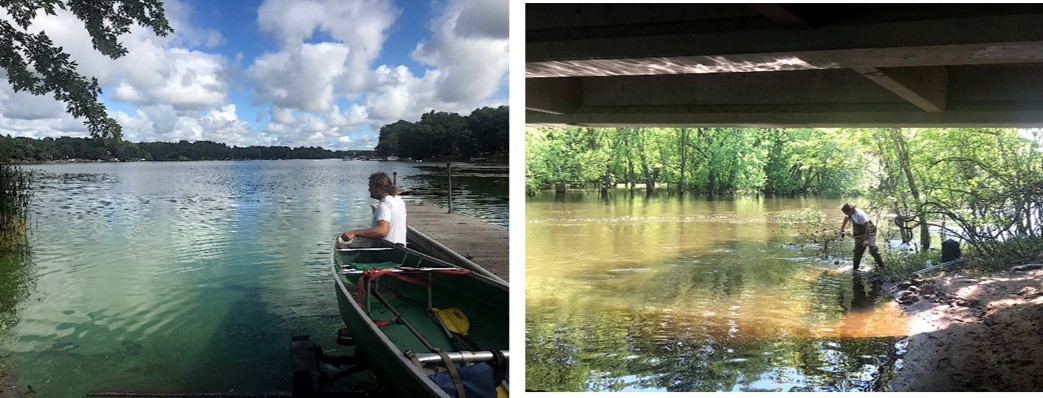
2019 was another successful monitoring season for The Anoka Conservation District (ACD). Strong partnerships with watershed districts, watershed management organizations, and local lake associations, allowed ACD to implement a variety of monitoring programs including; daily precipitation totals (12 volunteers), lake levels (25 lakes), lake water quality (11 lakes), stream hydrology (12 sites), stream water quality (18 sites), stream benthic macroinvertebrates (3 Anoka County schools), shallow groundwater levels in wetlands (19 sites) and deep groundwater levels in observation wells (24 sites).

2019 ended up being the wettest year on record for the state of Minnesota with a state-wide average of 35.51 inches, breaking the previous record of 33.93 inches set in 1977. Due to the banner year Minnesota had with rainfall, we saw historically high water levels in lakes and streams and higher than average groundwater levels in many wetlands and groundwater wells. 2019 was a great year for overall water quality, with many of the lakes and streams showing improvements compared to the historical average.

With a growing population and ever-increasing development, it is more important than ever to have the ability to make informed decisions when it comes to land use management and for local leaders to have an understanding of how those decisions may affect natural resources. Water resources are rapidly declining in quality and quantity throughout the metro. Anoka County is fortunate enough to still have many pristine natural areas but it will take a team effort to keep them that way.

  3932 Hits